
What it is
A Tool is a product used by an organization to perform functions or tasks. A tool may be software, hardware, or a combination of both.
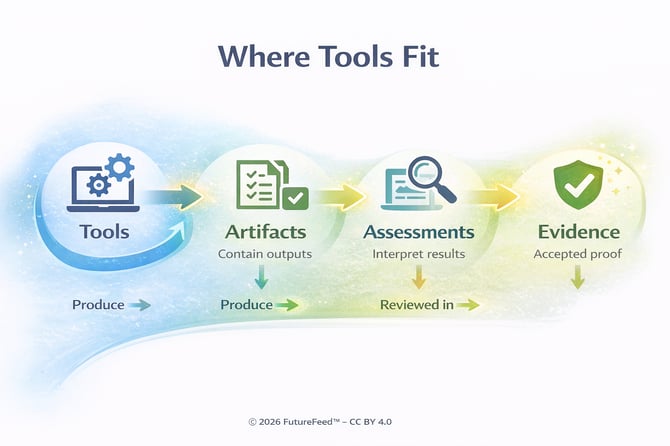
Cybersecurity tools carry out actions such as scanning, monitoring, logging, enforcing settings, calculating results, or generating outputs. They are mechanisms for doing work, not statements of intent or judgment.
A tool exists independently of any particular policy, assessment, or audit.
Why tools exist
Organizations use tools to:
-
Automate work
-
Increase consistency
-
Reduce manual effort
-
Monitor systems and activity
-
Enforce configurations
-
Generate information and records
Tools make work possible at scale, but they do not define whether the work is sufficient, correct, or compliant.
Common examples of tools
-
Vulnerability scanning tools
-
Penetration testing platforms
-
Logging and monitoring systems
-
Ticketing systems
-
Identity and access management systems
-
Configuration management tools
-
Cloud service platforms
-
Security testing and analysis tools
Tools vs Assessments
Tools may be used as part of an assessment, but a tool is not an assessment by itself.
-
A tool performs tests or collects information
-
An assessment evaluates results and draws conclusions
For example, a vulnerability scanner is a tool. Running it produces results. Reviewing and interpreting those results is an assessment.
Tools vs Artifacts
Tools often produce artifacts, but they are not artifacts themselves.
-
Tools are used to support performance of a service
-
The output (report, export, log, screenshot, or record) may be an artifact
Those artifacts may later be reviewed and accepted as evidence.
Tools vs Services
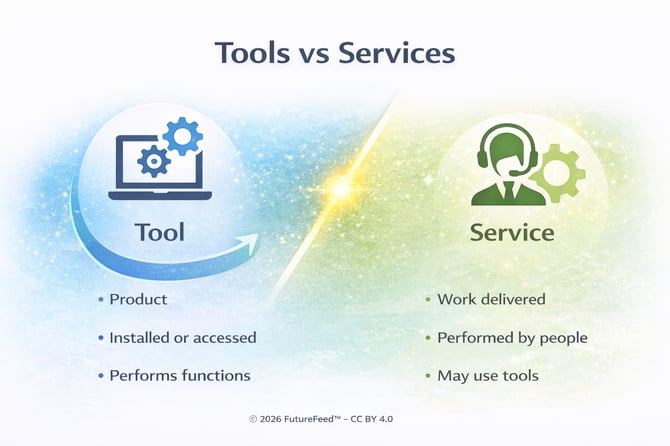
A tool is a product.
A service is work performed by people, often using tools.
For example:
-
A vulnerability scanner is a tool
-
A managed vulnerability scanning offering is a service that employs the tool
Tools may be purchased or built internally. Services are often performed using tools.
How tools are represented in FutureFeed
In FutureFeed, Tools and Services are grouped together for efficiency. They may be:
-
Documented as part of the organization’s environment
-
Referenced by assessments or audits
-
Sources of artifacts and evidence
-
Associated with configurations, processes, or services
The presence of a tool does not imply effectiveness or compliance. What matters is how the tool is configured, used, and reviewed.
Common confusion
In practice, tools are often described as “doing the assessment,” “being the evidence,” or “providing compliance.” This shorthand is common but imprecise.
In this documentation model:
-
Tools perform functions
-
Assessments evaluate results
-
Artifacts record outputs
-
Evidence represents artifacts that have been reviewed and accepted proof
Keeping these roles distinct helps organizations understand what exists, what happened, and what conclusions were reached.
Why this matters
Clear distinctions between tools, assessments, artifacts, and services help organizations:
-
Avoid overstating conclusions
-
Organize documentation consistently
-
Track results over time
-
Communicate clearly with stakeholders